Explyt 5.19: your subscription in Claude Code, Cursor, Codex, and other tools
Any coding agent, whether a CLI, a desktop application, or an editor, is split into two parts: a client that reads files and calls tools, and a model that the client queries for answers. The model is connected through a provider: an API address and a key. An Explyt subscription has always been such a provider, with OpenAI and Anthropic models behind a single OpenAI-compatible address, but until 5.19 only the plugin for JetBrains IDEs knew the address and the key.
In 5.19, both values are shown in your personal account, in the Connect to Explyt block. You enter them into the provider settings of Claude Desktop, Claude Code, Cursor, Kilo Code, Cline, OpenCode, Codex in ChatGPT, or Codex CLI, and the tool starts sending model requests to the Explyt gateway. Minutes are spent from the same balance as in the plugin; the remaining amount is visible in your personal account.
For a developer, this means one subscription to OpenAI and Anthropic models across all working tools, without separate accounts with each provider. If a model from one provider plans a task better and a model from another writes the implementation better, you switch between them within one balance.
Only the model is passed through the key. Project navigation, run configurations, the debugger, IDE-powered refactoring, skills, and Explyt agent modes stay in the plugin for JetBrains IDEs. The plugin's MCP server from version 5.17 passes these tools to an external agent, so the two mechanisms complement each other: the model through the gateway, the tools through MCP.
In the plugin itself, two places were fixed where the agent relied on its own estimate instead of data from an external system. The context indicator counted tokens locally and underestimated the fill level by about a third, because code and tool results tokenize more densely than prose; the estimate is now checked against the input token count from the provider's response. MCP servers with browser sign-in issue a token for an hour, while an IDE session lives longer; the plugin now renews the token before it expires instead of asking you to reconnect manually.
Contents
- Subscription minutes in other tools
- Where to get the URL and key
- Which tools you can connect
- Which models are available
- What is not passed through the key
- Explyt plugin: Personal or key
- The context indicator shows the real fill level
- Automatic renewal of MCP server access tokens
- Performance and fixes
- Choose the right feature for your task
- After updating from a previous version
- Update Explyt
Subscription minutes in other tools
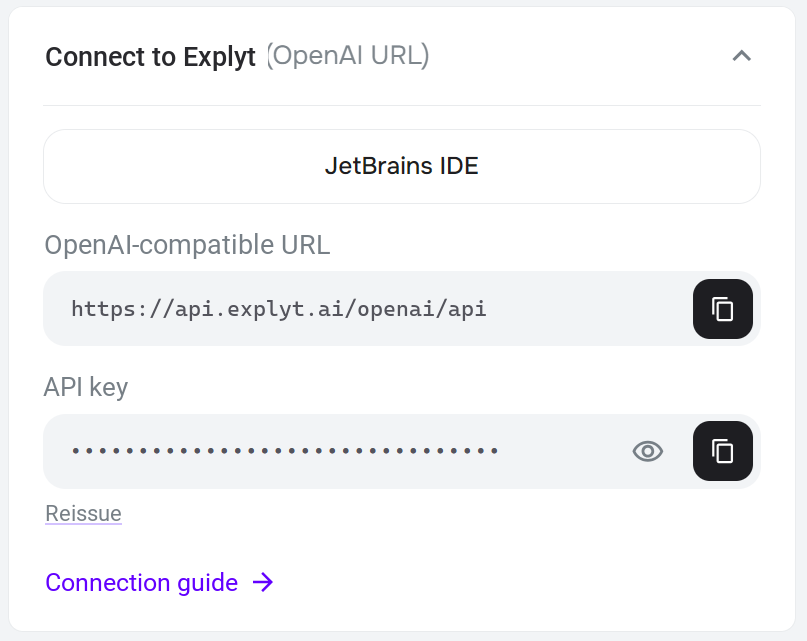
An Explyt subscription gives access to models through a single OpenAI-compatible address, https://api.explyt.ai/openai/api. Until 5.19, only the plugin used this address. Now third-party tools connect to it as well: minutes are spent the same way as when you work from the plugin, and the remaining balance is visible in your personal account.
In practice, this means you do not need to keep several subscriptions with different providers to use OpenAI and Anthropic models from several tools. One Explyt subscription, one key, one balance in your personal account. If a model from one provider plans a task better and a model from another implements it better, you can switch between them within one subscription.
Where to get the URL and key
Both values are in your personal account, in the Connect to Explyt block:
- OpenAI-compatible URL:
https://api.explyt.ai/openai/api. It is the same for all users. - API key: your personal key. The Copy key button copies the value; the eye icon shows it.
The key is shared by all tools. If it has leaked or stopped working, click Reissue: the old key stops working immediately, and you need to put the new one into every configured tool.
If the Connect to Explyt block is not shown, activate a subscription or top up your Flex minutes balance in the same account. The terms are described on the Plans and balance page.
Which tools you can connect
Step-by-step instructions for each tool and a walkthrough of common errors are collected in the Connecting external tools to Explyt section:
| Tool | Type | Notes |
|---|---|---|
| Claude Desktop | Desktop application | OpenAI and Anthropic models |
| Claude Code | CLI agent | OpenAI and Anthropic models |
| Claude Code for VS Code | VS Code extension | OpenAI and Anthropic models |
| Cursor | Editor | OpenAI and Anthropic models |
| Kilo Code | VS Code extension | OpenAI and Anthropic models |
| Cline | VS Code extension | OpenAI and Anthropic models |
| OpenCode | CLI agent | OpenAI and Anthropic models |
| Codex in ChatGPT | Desktop application | OpenAI models and auto only |
| Codex CLI | CLI agent | OpenAI and Anthropic models |
| Explyt plugin | JetBrains IDE | Personal plan or connection by key |
The list grows as tools are verified. If your client is not in the table but accepts an OpenAI-compatible address and a key, the connection will most likely work, but we have not tested it yet.
Which models are available
The gateway provides OpenAI and Anthropic models, as well as the auto model, which selects a suitable model itself and ensures maximum availability. The full up-to-date list is returned by a request to https://api.explyt.ai/openai/api/models with the header Authorization: Bearer <YOUR_API_KEY>. Some tools load this list automatically.
The Codex app in ChatGPT works only with OpenAI models and auto. Anthropic models with Codex are available through Codex CLI.
What is not passed through the key
The key gives access to models and nothing else. The external tool will not get:
- IDE tools: project navigation, run configurations, the debugger, IDE-powered refactoring;
- Explyt agent skills, modes, rules, and checks;
- subscription data in the third-party tool's interface: the remaining minutes and the usage of the current chat are visible in your personal account.
If an external agent needs IDE tools, use the MCP server of the Explyt plugin: it passes selected tool groups without its own inference and does not require a subscription. The key and the MCP server solve different problems and can work together: the model through the Explyt gateway, the tools through MCP.
Explyt plugin: Personal or key
The plugin for JetBrains IDEs can work with your subscription in two ways:
- Personal: sign in to your Explyt account right from the plugin, no key needed. This is the main way.
- Community: connect to the gateway with the OpenAI-compatible URL and the API key, the same way third-party tools connect.
Minutes are spent the same way. The difference is the integration: in Personal, the plugin knows about your subscription and shows the remaining minutes, the usage of the current chat, and the up-to-date list of models with their parameters. In Community, the plugin sees the gateway as an OpenAI-compatible provider and does not get this data. If you have no particular reason to use a key in the plugin, you do not need to.
The context indicator shows the real fill level
The context fill bar in the chat underestimated the size of the history by about a third. A chat that had already hit the model limit looked like it still had plenty of room: history auto-compression did not start, and the request ended with a provider error. The underestimated value also distorted the estimate of minutes spent in the chat.
The reason is the composition of an agent chat history. It consists mostly of code and tool results, and such text splits into tokens more densely than prose. A local estimate calibrated for prose produced a systematic error.
In 5.19, Explyt checks its estimate against the input token count that the provider reports after each response and corrects the indicator. The correction is saved with the chat, so after an IDE restart a long conversation will not look half-empty again. No additional setting is required.
Automatic renewal of MCP server access tokens
Some MCP servers issue an access token after you sign in through the browser. Such a token usually lives about an hour, while an IDE session lives noticeably longer. The first tool call after expiry failed and sent you to the settings to reconnect.
Explyt now renews the token ahead of time, while the old one is still valid. If several such servers are connected, each gets its own token instead of another server's.
After updating to 5.19, you will need to sign in through the browser once more for each such server. Servers with a manual authorization header and local servers are not affected.
Performance and fixes
Fewer file system calls
Explyt accesses the file system less often when checking paths that the agent mentioned but that do not exist in the project.
Compressed history for forks and subagents
Forks and subagents now receive the already compressed chat history. Previously, after compression, a fork paid for all the saved tokens again. We also fixed cases where a chat stopped sending messages after compression and restored saved chats that were damaged by this error earlier.
Choose the right feature for your task
| Task | Explyt 5.19 feature | What to check |
|---|---|---|
| Spend your Explyt subscription in Claude Code, Cursor, Codex CLI, or OpenCode | Gateway URL and API key from your personal account | The key is entered instead of signing in to the tool's own account; remaining minutes in the account |
| Use Anthropic models with Codex | Codex CLI through the Explyt gateway | The Codex app in ChatGPT supports OpenAI models and auto only |
| Give an external agent IDE tools | MCP server of the Explyt plugin (since 5.17), no subscription required | Enabled tool groups and the call log; the subscription key is not needed for this |
| See remaining minutes and chat usage in the interface | Explyt plugin in Personal | In Community and in external tools, this data is available only in your personal account |
| Understand why a long chat ran into a provider error | Fixed context indicator | Fill level after the first model response; start history compression if needed |
| Stop reconnecting an MCP server with browser sign-in | Automatic token renewal | One repeated sign-in after the update, then no manual actions |
| The key has leaked or stopped working | The Reissue button in your personal account | The new key is entered into every configured tool |
After updating from a previous version
Existing chats and settings keep working. For the new features, check the following:
- Open your personal account and make sure the Connect to Explyt block is shown. If it is not, activate a subscription or top up your Flex minutes.
- When connecting an external tool, enter the Explyt key instead of signing in to that tool's account. Signing in with a ChatGPT or Anthropic account sends requests past the gateway, and they will be rejected.
- Treat the key as a password. If it leaks, reissue it and update it in every tool.
- For MCP servers with browser sign-in, sign in again once.
- To estimate usage in a long chat, rely on the indicator after the first model response: before that point, a local estimate is shown.
Update Explyt
Open Settings | Plugins | Installed, find Explyt, and click Update if an update is available. Restart the IDE after installation if prompted.
If Explyt is not installed yet, download the plugin from the Explyt download page and follow the installation instructions. Connecting external tools does not require the plugin: a subscription and the key from your personal account are enough.