Install and setup
Explyt Spring is published on the JetBrains Marketplace as Spring Explyt (plugin id 28675). It targets IntelliJ IDEA — both Community and Ultimate editions.
For the exact IDE versions supported and which features require which version, see Compatibility.
Install from the JetBrains Marketplace
The recommended route.
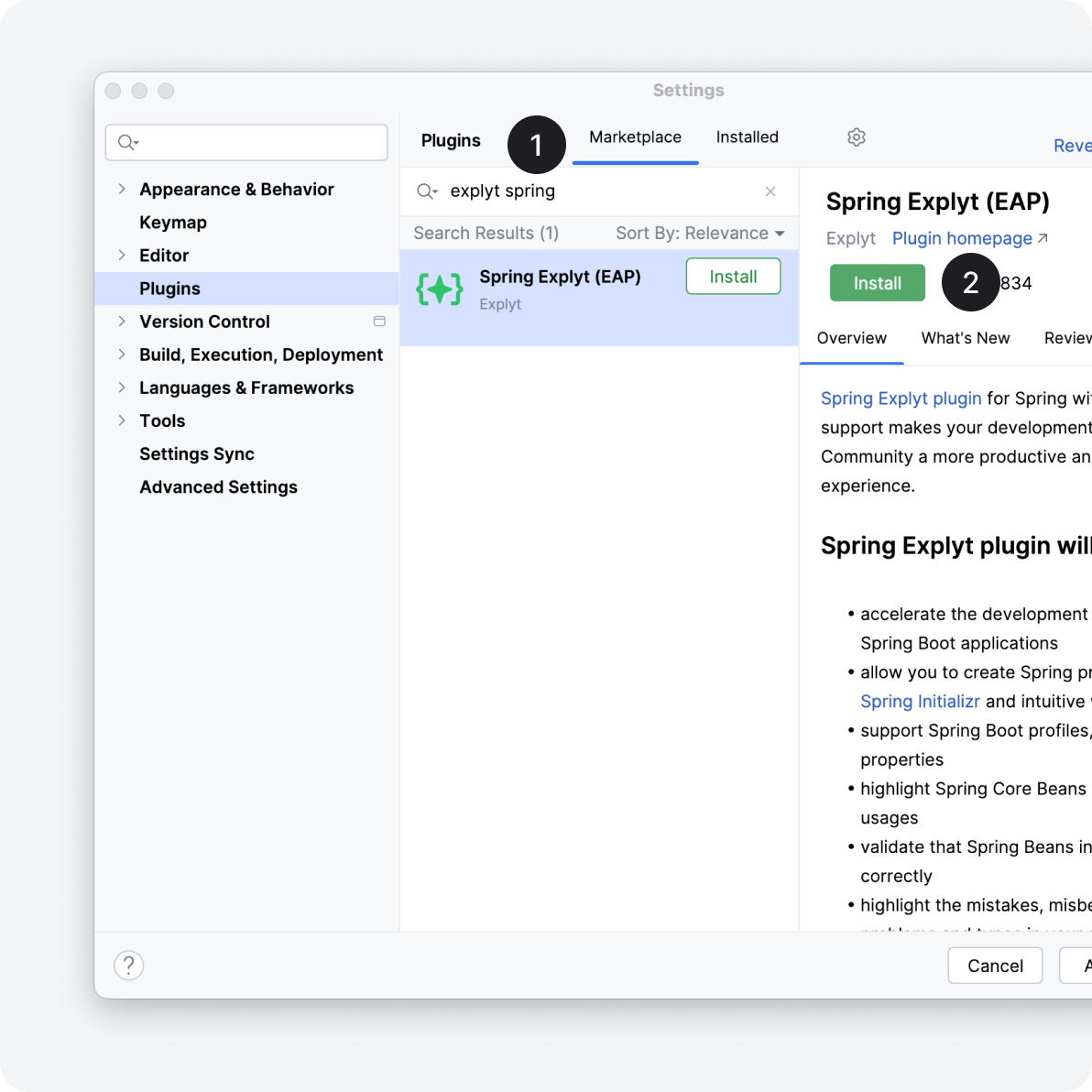
- Open Settings (Preferences) → Plugins.
- Switch to the Marketplace tab and search for Spring Explyt.
- Click Install, then restart the IDE when prompted.
You can also install from the browser at plugins.jetbrains.com/plugin/28675-spring-explyt — if the IDE is running, it will pick up the request.
Install from the Explyt repository
Use this if you prefer a custom repository or cannot reach the JetBrains Marketplace directly.
- In Settings (Preferences) → Plugins, click the settings icon.
- Choose Manage Plugin Repositories.
- Click + and paste
https://repository.explyt.dev/ - Click OK, then find and install the plugin from the Marketplace tab.
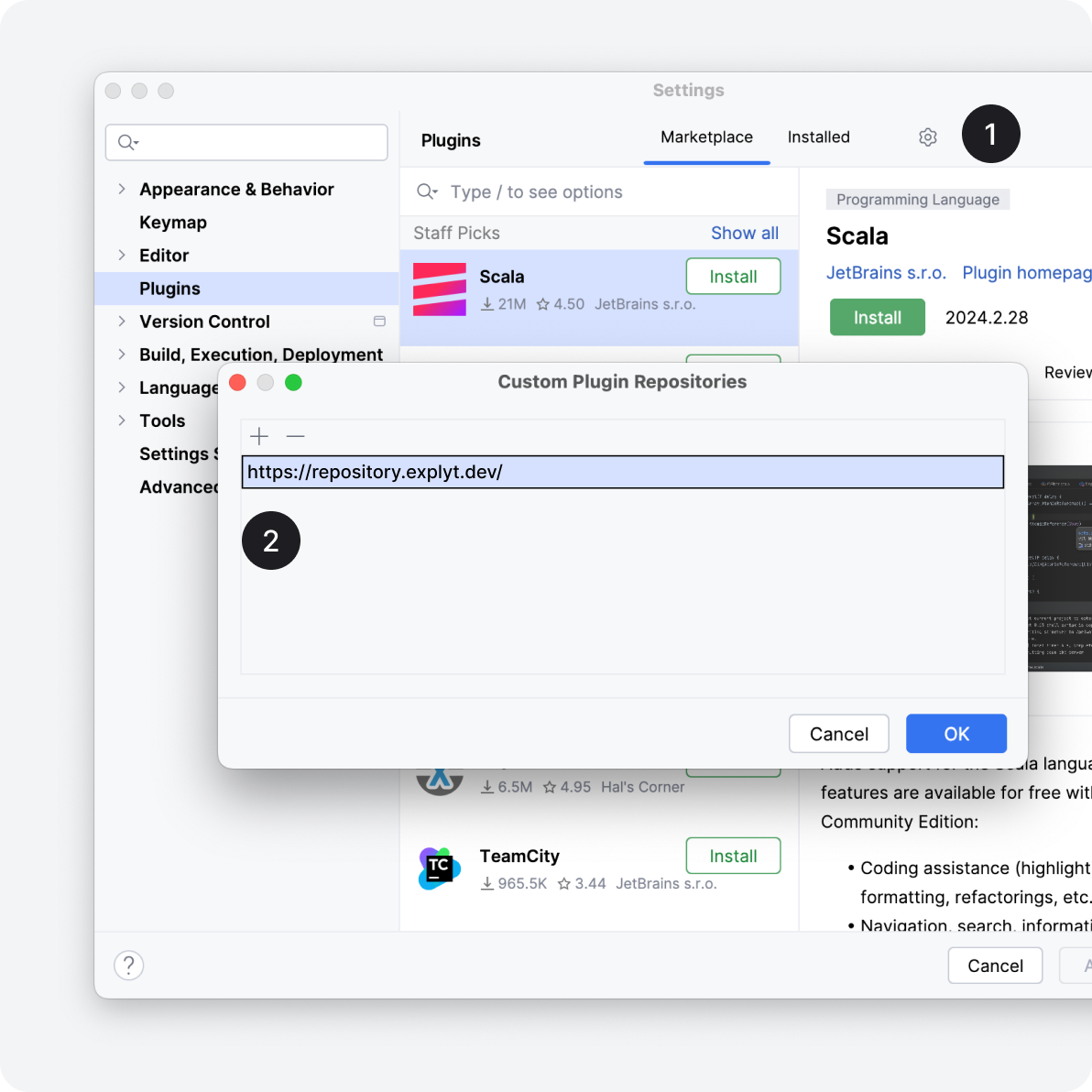
Make sure there is no stray whitespace before or after the URL.
Install manually from a ZIP
- Download a
.zipfrom the releases page. - Go to Settings → Plugins, click the settings icon, and choose Install Plugin from Disk.
- Select the ZIP and restart the IDE.
Manual installs do not receive automatic updates. Prefer the Marketplace unless you need a specific build.
First-time setup
- Open the Explyt Spring and Explyt Endpoints tool windows from the right sidebar.
- In Explyt Spring, click Link Explyt Spring Boot Project From RunConfiguration and choose the run configuration that starts your application. This compiles the project and loads the real bean model — see Native Context Mode.
- Optionally configure a runner for
.httpfiles, as described in.httpand.restfiles.
The Quickstart walks through this with the surrounding workflows.
Settings
Plugin settings live under Settings → Tools → Explyt Spring → Spring Boot.
| Setting | Default | What it controls |
|---|---|---|
| SpringBoot configurations auto-detection | On | Whether the plugin automatically discovers Spring Boot run configurations. |
| 'ConditionalOn' bean filtering | On | When enabled, conditional filtering applies everywhere. When disabled, it applies only to auto-configurations. |
| Collect statistics of user actions | On | Anonymous usage statistics. |
| Show floating button on editor for refresh ExplytSpringBoot projects | On | The in-editor refresh button for reloading the bean model. |
| Enable Spring debug mode | On | The Spring-aware debugger described in Spring Debugger. |
| Use javaagent to resolve beans | On | How the bean model is built. With this off, a custom main startup method is used instead of the javaagent. |
| Native SQL Language ID | Empty | The language to inject into native SQL strings, if you want a specific SQL dialect from another plugin. |
| HttpClient CLI Path | Empty | The runner used for .http and .rest files, with a Download HttpClient Cli button beside it. |
The HttpClient CLI Path row only appears when the bundled Shell Script plugin is enabled.
Changing these settings invalidates the plugin's cached model, so the next analysis pass rebuilds it.
Using IntelliJ IDEA Ultimate
Explyt Spring works in Ultimate as well as Community. Because Ultimate has its own Spring support, you may see duplicated gutter icons or conflicting inspections; recent versions suppress Explyt's markers when Ultimate's Spring support is active. If you still see conflicts, disable the bundled Spring plugin in Settings → Plugins.
Updating and uninstalling
Marketplace and custom-repository installs update through Settings → Plugins, like any other plugin. To remove the plugin, uninstall it there and restart the IDE. Detaching linked projects first is not required — the plugin's model is stored outside your project sources.
See also: Quickstart · Compatibility · Troubleshooting