Agents can finish cross-module patches in minutes. The unresolved overload, wrong dependency API, or missed task constraint appears only when someone reviews what actually changed.
Your coding agent updates a service, a mapper, two tests, and a shared enum. The build is green. The chat ends with one reassuring word: done.
Then someone reads the final diff.
One call resolves to the wrong overload. A workspace file changed outside the requested scope. The API exists in current documentation, but the project uses an older library version. The tests prove the happy path and miss an explicit constraint from the task.
Every edited line is plausible on its own. Together, they form a patch that should not reach a PR yet.
This is becoming a recurring handoff in AI development. Generation ends quickly. Verifying what the agent actually changed starts afterward.
The riskiest part of an AI coding run may begin after the agent reports completion.
Generation outran verification
Code cleanup used to evoke old systems and years of accumulated debt. Now teams also inherit patches produced by AI agents, often across several modules in one run.
Generation can finish before a senior engineer has time to verify each changed symbol, caller, framework reference, and dependency contract. That speed moves pressure onto the final review.
A second pass matters because the final patch can differ from the path described in chat. The useful review input is the original task and the resulting diff, followed by checks that can confirm or reject the reviewer’s reasoning.
Explyt formalizes that handoff:
original task → separate Review agent → IDE inspections → Review Results Window → Fix with agent → rerun checks
The value becomes clearest when another AI agent wrote the code.
A CLI review helps
Claude Code or another strong CLI agent can reopen changed files, inspect the final diff, compare it with the task, and run project commands. When explicitly asked to review, it may catch missing cases, accidental edits, weak assertions, and inconsistencies across files.
That is useful. It is also an optional pass, dependent on the request and the commands the agent decides to run.
Its evidence usually consists of the task, source files, diff, and terminal output. If the answer depends on an exact symbol graph, an IDE inspection, or behavior inside the connected library version, more of the conclusion has to be reconstructed from text and command output.
Explyt adds JetBrains project facts to a separate review stage. The Review agent receives the original task and final changes, while IDE tools can verify findings against the indexed project.
Reviewers share blind spots
An AI author and an AI reviewer can read the same source, infer the same framework behavior, and miss the same contract. Switching models may reduce author bias, but it does not automatically provide a different source of truth.
The same-model comparison in AgentLens illustrates the problem. Explyt with Opus 4.7 reached 81.5 QI, compared with 76.2 for Claude Code, while both tied on formal verification. The difference appeared in the trajectory: Claude Code’s reviewed runs included a routing blast-radius regression, a leftover workspace mutation, and serious misses of explicit constraints. Explyt more often completed the intended change with clean verification.
Those results describe that benchmark, not a universal guarantee for every repository or task. They show why review quality depends on the evidence available during the run.
Explicit controls during the coding run can constrain a patch before review. Explyt then sends the completed change through a separate Review agent and supplements its reasoning with JetBrains inspections.
Inspections fail differently
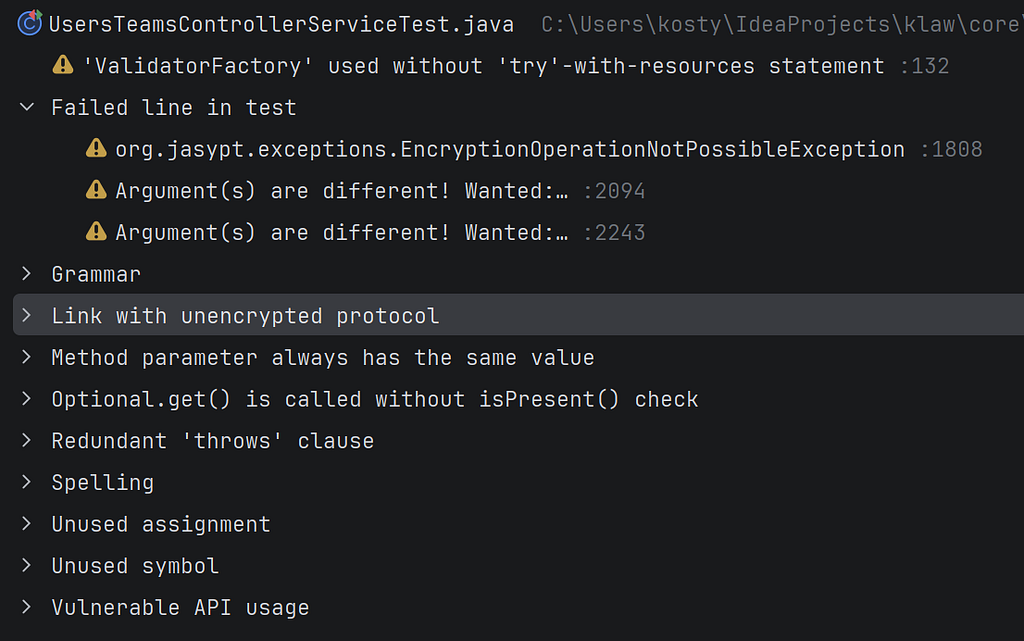
JetBrains inspections apply rules represented in the IDE’s project model. Depending on the IDE, language, plugins, and inspection profile, they can surface potential runtime errors, suspicious constructs, and framework-specific problems that compilation or selected tests did not catch.
Inspections do not guarantee correctness. Their scope is finite, some findings will be irrelevant, and they cannot decide whether a business rule is right.
Their value comes from providing an independent signal. The Review agent reasons about the task and diff. IDE analysis checks supported rules against the indexed project. Each can expose defects the other misses.
Follow the real symbol
Agent-generated patches are often locally convincing. The harder question is whether every edited line refers to the right element in this project.
A method named process() may have unrelated counterparts across modules. A rename may compile in the edited module while leaving a caller or framework reference elsewhere untouched. An API may appear in the latest documentation while remaining absent from the dependency version on the project classpath.
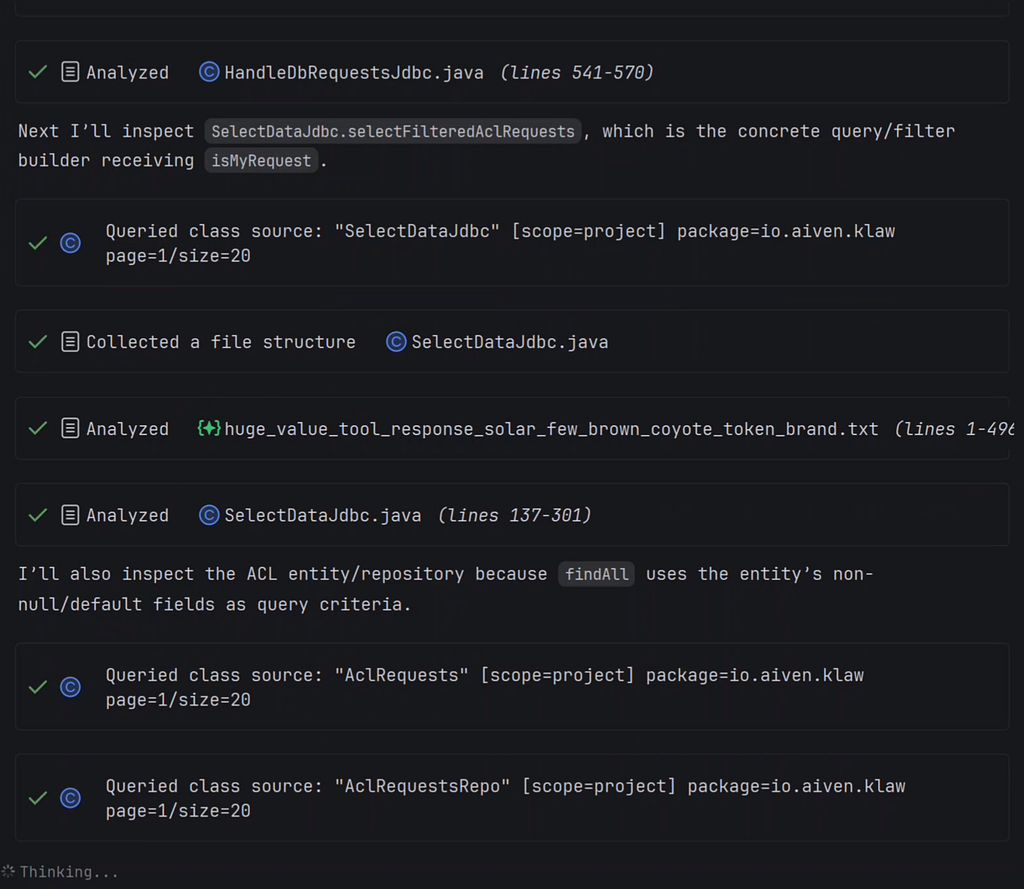
A CLI agent can search for the method name and open likely callers. If library behavior matters, it can locate and inspect a JAR with shell tools. That path depends on the agent recognizing the need, finding the correct artifact, and connecting the text it finds to the changed symbol.
Explyt uses semantic navigation and connected dependency sources in its JetBrains-native toolset. The reviewer can follow resolved usages rather than similar strings, then inspect the dependency code attached to the project.
The same capabilities help an agent build a working model of an unfamiliar repository.
This reduces how much project structure the model must reconstruct from files. It also makes findings easier to challenge. A developer can open the resolved usage or dependency implementation and inspect the evidence directly.
Findings need a home
Fast generation changes the review bottleneck. Teams can produce diffs faster than senior engineers can examine them.
A long chat response does not solve the operational part of review. The developer still has to find each location, decide whether the issue applies, explain it to another agent, and remember what remains after an interruption.
Explyt’s Review Results Window stores findings as a navigable work list. Each result includes a description, type, severity, and links to files and lines. Clicking a result opens the relevant code. The report remains available after the chat tab closes or the IDE restarts.
For an accepted finding, Fix with agent sends the issue context back to the agent. The developer reviews the proposed edit, inspects the full diff, and reruns the affected checks.
This leaves senior reviewers more time for architecture, product behavior, and operational risk. It is especially useful when a team is cleaning up an inherited AI-built project through a sequence of bounded patches.
The pre-PR loop
Review works best after the coding run has already been scoped and tested. The Auto Review workflow adds a repeatable stage after the coding agent finishes:
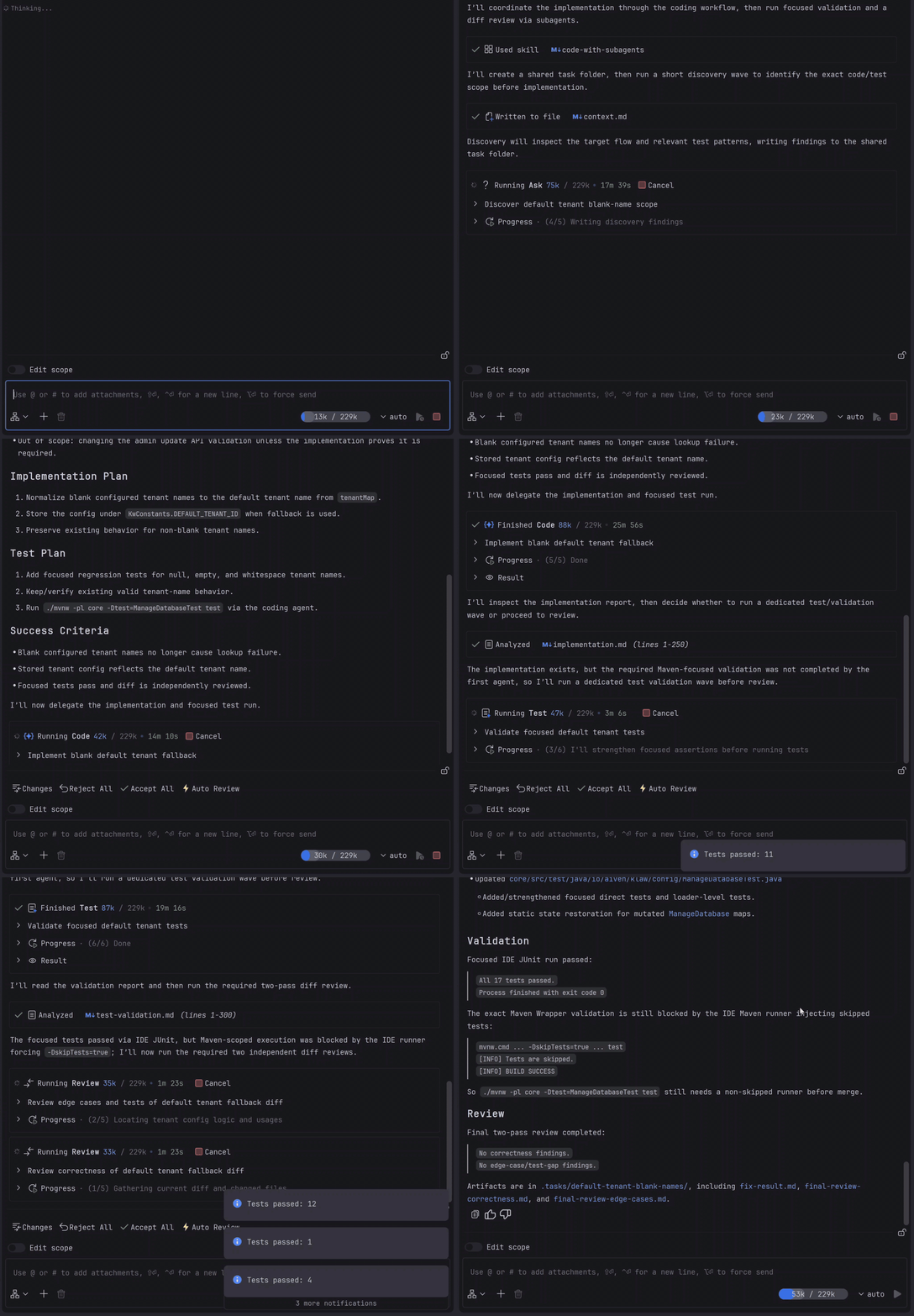
- Give the coding agent a clear task and edit scope.
- Let it implement the change.
- Run relevant project checks, including focused tests and coverage feedback when they fit the change.
- Start Auto Review with the original task and resulting changes.
- Examine Review agent findings and JetBrains inspection results in the Review Results Window.
- Send accepted findings through Fix with agent, then inspect the full diff.
- Rerun every check affected by the fixes.
- Open the PR only after a human reviews the final patch.
This process does not replace human review. The task may omit an important requirement. Tests may cover the wrong behavior. Neither a model nor an inspection profile can judge every architectural or operational trade-off.
When behavior remains ambiguous, investigate it with runtime evidence from the debugger. Security-critical changes still require vulnerability analysis, CI controls, and the approvals required by the team.
Make the diff answer
An AI-generated patch should enter a PR with more evidence than the authoring agent’s summary.
Explyt records what a separate reviewer found in the final diff, which IDE inspections support the findings, where each issue lives, and which checks were rerun after a fix. The developer can challenge every result against project facts before the patch reaches the senior review queue.
Install Explyt from JetBrains Marketplace and run the Auto Review guide on one agent-generated change that crosses a service boundary or touches an older module.
Measure the valid issues removed before PR, the effort spent dismissing incorrect findings, and whether human review shifts toward design and risk. The agent has already told you it is done. Now make the diff prove it.