An AI agent can return a large patch quickly. The developer still has to understand the changes, verify the result, correct missed cases, and decide whether the patch is safe to accept. If that work takes longer than completing the task manually, the agent has added cost rather than saved time.
Request counts, generated lines, and token use describe model activity and cost. To measure value, the team needs two stronger signals: the change in active developer time and whether the result met predefined acceptance criteria.
Evaluate each task on three parameters:
- how precisely the team can define the required result;
- which independent checks can confirm it;
- what happens if an error passes every check.
This article calls the parameters certainty, verifiability, and error cost. Each level has observable criteria. Two assessors record their evidence and rationale independently, while the team measures assessor agreement separately.
Before a pilot, the team estimates the share of tasks that may support autonomous agent work within defined boundaries. Afterward, it calculates the confirmed share: tasks where the agent reduced active developer time and the result met the predefined acceptance criteria.
What does "hand a task to an agent" mean?
In one team, delegation means asking the agent to find the required class. In another, the agent receives a task, changes the code, runs checks, and returns a patch for review. Comparing such results with a single percentage is meaningless.
Define the workflow in six steps:
- Gather project context and find the affected locations.
- Clarify requirements and constraints.
- Propose a change plan.
- Change code, tests, configuration, or documentation.
- Run checks and fix the problems found.
- Accept the result and approve it for merge, release, or publication.
In this method, a delegated task includes the agent’s autonomous work on actions one through five within agreed boundaries. The developer sets the acceptance criterion, reviews the evidence, and makes the final decision.
For the remaining tasks, the team chooses one of two modes:
- short-step collaboration: the agent investigates or changes a small part, and a person checks the direction before the next step;
- preparatory assistance: the agent collects information, looks for dependencies, prepares options or test data, while a person makes the decision and performs the main change.
This division prevents preparatory assistance from being presented as autonomous delegation. Searching documentation with a model is useful in itself. The ability to assign the agent a change to payment logic requires a separate check.
Unit of evaluation: a specific task in a specific project
A category name is too broad. “Write tests” may mean three unit tests for a pure function with a clear contract or restoring integration coverage after the migration of several modules. “Perform a refactoring” may mean renaming a local symbol or moving a shared data model between services.
Before scoring, the task card must state:
- expected result;
- permitted change area;
- known constraints;
- available checks;
- affected users and systems;
- rollback method;
- person responsible for acceptance.
If a card combines several independent results, it is better to split it. An agent may handle updating a DTO well and handle changing authorization rules poorly, although both changes are part of one tracker task.
Reproduce, inspect and fix inside JetBrains IDEs, with the debugger, run configurations and IDE facts as evidence.
Three task-fit parameters
Score each parameter from 1 to 3, but keep the scores separate. A combined score would distort the evaluation: high verifiability does not reduce error cost, and a clear requirement does not create an independent checking method.
1. Certainty of the result
Certainty answers the question: can the team describe, before implementation begins, what should change and what should remain unchanged?
Level 1: low
Assign 1 if at least one condition applies:
- the product owner has not yet selected the required behavior;
- the task contains several architectural directions without an agreed selection criterion;
- it is unknown which systems or processes depend on the change;
- the documentation and code diverge, and the source of truth has not been defined;
- the expected result can be formulated only after investigation;
- the boundaries of the change cannot be named even at the module or component level.
Example: determining the boundaries for splitting a monolith into services when transactional relationships and data-consistency requirements are unknown.
Level 2: medium
Assign 2 if the main behavior is agreed but one or more limited questions remain:
- the result for the main scenario is known, but individual edge cases are not defined;
- the change area is clear at the subsystem level, while the exact file list will appear after analysis;
- there are two acceptable technical options, and the selection criterion is defined;
- some dependencies must be confirmed in code or configuration;
- work can begin without another product decision, but the team must reach a human checkpoint after the investigation and before proceeding.
Example: adding request retries with an agreed number of attempts when the method for storing state must be chosen after checking the existing infrastructure.
Level 3: high
Assign 3 only if all conditions are met:
- the result is described by a contract, examples, or precise acceptance scenarios;
- the boundaries of permitted changes are defined;
- unchanged behavior is listed;
- external dependencies and constraints are available to the agent or explicitly stated;
- product and architectural decisions have already been made;
- two developers can independently read the task description and expect the same result.
Example: fixing a reproducible serialization defect in one module while preserving the public schema and existing behavior of the other formats.
If assessors disagree between levels 2 and 3, keep the task at level 2 until the team provides evidence that resolves the disagreement. That evidence may be a product-owner decision, an API contract, an edge-case table, or a list of permitted modules.
2. Verifiability of the result
Verifiability answers the question: will the team be able to confirm the result independently of the agent’s explanation?
An independent check relies on a basis different from the agent’s implementation. A test written by the agent together with the code from one ambiguous task description helps find some errors. A predefined acceptance scenario provides stronger confirmation.
Level 1: low
Assign 1 if at least one sign is present:
- correctness can be assessed only by reading a large or complex change;
- there is no reproducible scenario, and observable behavior depends on the production environment;
- tests are absent, unstable, or test another part of the system;
- the success criterion is formulated subjectively;
- the team cannot show a state before the change in which the criterion has not yet been met;
- critical dynamic dependencies are not visible in the available checking environment.
Example: changing a distributed process whose error appears rarely and is diagnosed only from incomplete logs of several services.
Level 2: medium
Assign 2 if the main behavior can be checked but a noticeable area of manual control remains:
- there are tests for the main scenario, while some edge cases are checked manually;
- the build and static analysis are reproducible, but the integration environment is unavailable;
- the defect is reproducible, but confirmation that there are no regressions is limited;
- the diff can be checked in a reasonable time, but individual dynamic connections require review;
- there is one independent criterion and several confirmations created together with the implementation.
Example: a local fix with a failing unit test when the related integration scenario is checked manually only in a test environment.
Level 3: high
Assign 3 only if all conditions are met:
- there is an independent acceptance criterion;
- the unmet criterion can be shown before the change and the met criterion after it;
- the build and required tests are reproducible in the available environment;
- static or structural checks cover the affected connections;
- an observable runtime scenario exists for significant behavior;
- the final diff is limited and available for review;
- the team knows in advance which risks remain outside automated checks.
Example: fixing a defect in an isolated module when an existing test fails before the patch and passes after it, the entire module builds, the regression suite is stable, and the diff affects several understandable locations.
The level depends on the quality of the checks. Ten tests built on one incorrect expectation are weaker than one acceptance scenario specified by the behavior owner before implementation.
3. Error cost
Error cost describes the consequences of a defect that reaches a user or an internal process. Diff size does not predict impact: one line in an access-rights check may be more dangerous than a new internal tool consisting of hundreds of lines.
Assessors score the worst plausible consequence. An average scenario may conceal rare but critical damage.
Level 1: low
Assign 1 if all conditions are met:
- the error affects a limited internal audience or reversible work material;
- there is no risk of data loss, financial damage, access violation, or breach of contract;
- rollback takes a short time and does not require state restoration;
- the error is quickly detected by current checks or a user;
- dependent systems receive no irreversible changes.
Examples: a draft of internal documentation, report formatting, or a local developer tool without access to production data.
Level 2: medium
Assign 2 if the consequences are limited but require noticeable recovery:
- the error may disrupt part of the users or an internal process;
- data can be recalculated or restored from a reliable source;
- rollback is known but requires coordination or a time window;
- the public interface does not change, or the change is compatible;
- there is no direct risk to security, payments, legal obligations, or irreversible data.
Examples: a failure of an additional feature that can be quickly disabled by a flag, or an internal analytics error that can be recalculated.
Level 3: high
Assign 3 if at least one condition applies:
- financial losses or an incorrect payment calculation are possible;
- data may be lost, disclosed, or irreversibly damaged;
- the change affects authentication, authorization, secrets, or access boundaries;
- the error may violate a law, a contract, or a mandatory control;
- a critical public API or data format is affected without safe compatibility;
- rollback does not return the system to its original state;
- a failure may stop a critical service or affect a large share of users.
Examples: a production-data migration, changing a commission calculation, configuring access rights, or removing a public API field.
A release flag, backup, and tested rollback reduce practical risk but do not always change the level. If an incorrect operation manages to disclose data, a subsequent rollback will not eliminate the consequence.
How to choose a mode without conflicts in the matrix
The rules are applied from top to bottom. Once a condition is met, the lower rows are no longer considered. This order removes overlaps between high error cost, low verifiability, and high certainty.
| Priority | Condition | Work mode |
|---|---|---|
| 1 | Error cost = 3 | A person owns the decision and acceptance. The agent performs only limited steps defined and approved in advance. Independent review and a safe-release plan are required |
| 2 | Verifiability = 1 | Build a checking method first. Until then, assign the agent research, reproduction, and preparation of checks |
| 3 | Certainty = 1 | Work in short investigative steps. A person confirms the direction after each step |
| 4 | (Certainty = 2 or verifiability = 2) and error cost = 1 or 2 | Delegate a limited stage with a mandatory checkpoint and expanded review of the result |
| 5 | Certainty = 3, verifiability = 3, error cost = 2 | Work collaboratively: the agent performs a limited stage, a person confirms checkpoints and accepts the result after independent checking |
| 6 | Certainty = 3, verifiability = 3, error cost = 1 | The agent completes the full cycle to an acceptance-ready result. A person reviews the evidence and the final diff |
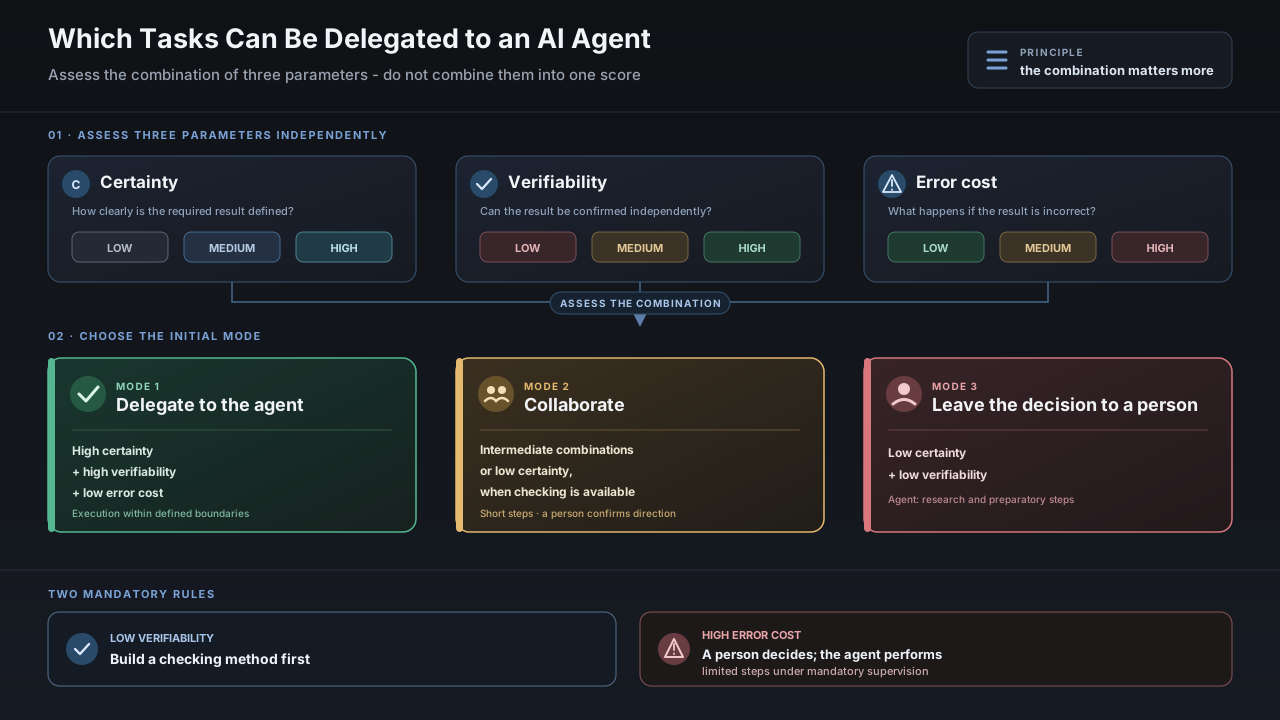
The infographic shows the same constraints in abbreviated form: autonomous delegation requires high certainty, high verifiability, and low error cost. With medium error cost, use a collaborative mode with human checkpoints. High error cost always leaves the decision with a person.
The matrix selects the initial mode for the task's current state. After investigation, certainty may rise from 1 to 2. A failing test and a reproducible run may raise verifiability. Controls such as isolation and tested rollback can reduce exposure or recovery time. Reassess error cost only when new evidence changes the worst plausible consequence itself.
Reassess the card before changing modes. You cannot assume that one successful attempt automatically raises the verifiability of an entire task category.
What evidence to attach to the assessment
Adjectives without artifacts quickly turn an assessment into an opinion. For each parameter, the card must contain a reference, file, test, decision, or described consequence.
For certainty, use:
- agreed input and output examples;
- an API contract or data schema;
- an edge-case table;
- a list of permitted modules;
- a product-owner decision;
- a list of behavior that must not change.
Verifiability requires executable or observable confirmations:
- a test that reproduces the defect before the change;
- separate acceptance or contract tests;
- a specific build and test configuration;
- static analysis and inspections with problem locations;
- semantic usage and reference resolution, plus compiler or IDE type checks, with the exact tool or configuration recorded;
- a run scenario with an observable result;
- debugger values and a call stack when runtime behavior is checked;
- the final diff and list of affected files.
For error cost, record:
- whom and which system the defect will affect;
- what data may change;
- how the team will detect the problem;
- whether error propagation can be stopped;
- how long recovery will take;
- which consequences will remain after rollback.
The wording “the risk is medium” does not help choose a mode. The record “the error will distort the internal report for the current day, source events are preserved, and recalculation takes up to an hour” provides a verifiable basis for level 2.
Where JetBrains IDE adds facts for acceptance
Verifiability depends on what information about the project the agent receives. File text and command output cover only part of the picture. In Java and Kotlin projects, JetBrains IDE stores a structural code model, symbol links, run configurations, test results, inspection messages, and application state during debugging.
Explyt receives these facts from JetBrains IDE during agent work. The agent can select a code entity, resolve its semantic usages and references, invoke an IDE operation, run a named configuration, and receive a diagnostic with its code location.
IDE facts strengthen checking when there is a predefined expectation. Successful compilation confirms the selected build area but says nothing about the product meaning of the change. A green test confirms only the scenario encoded in it. The debugger shows the state of one reproduced run, so a regression suite is still needed.
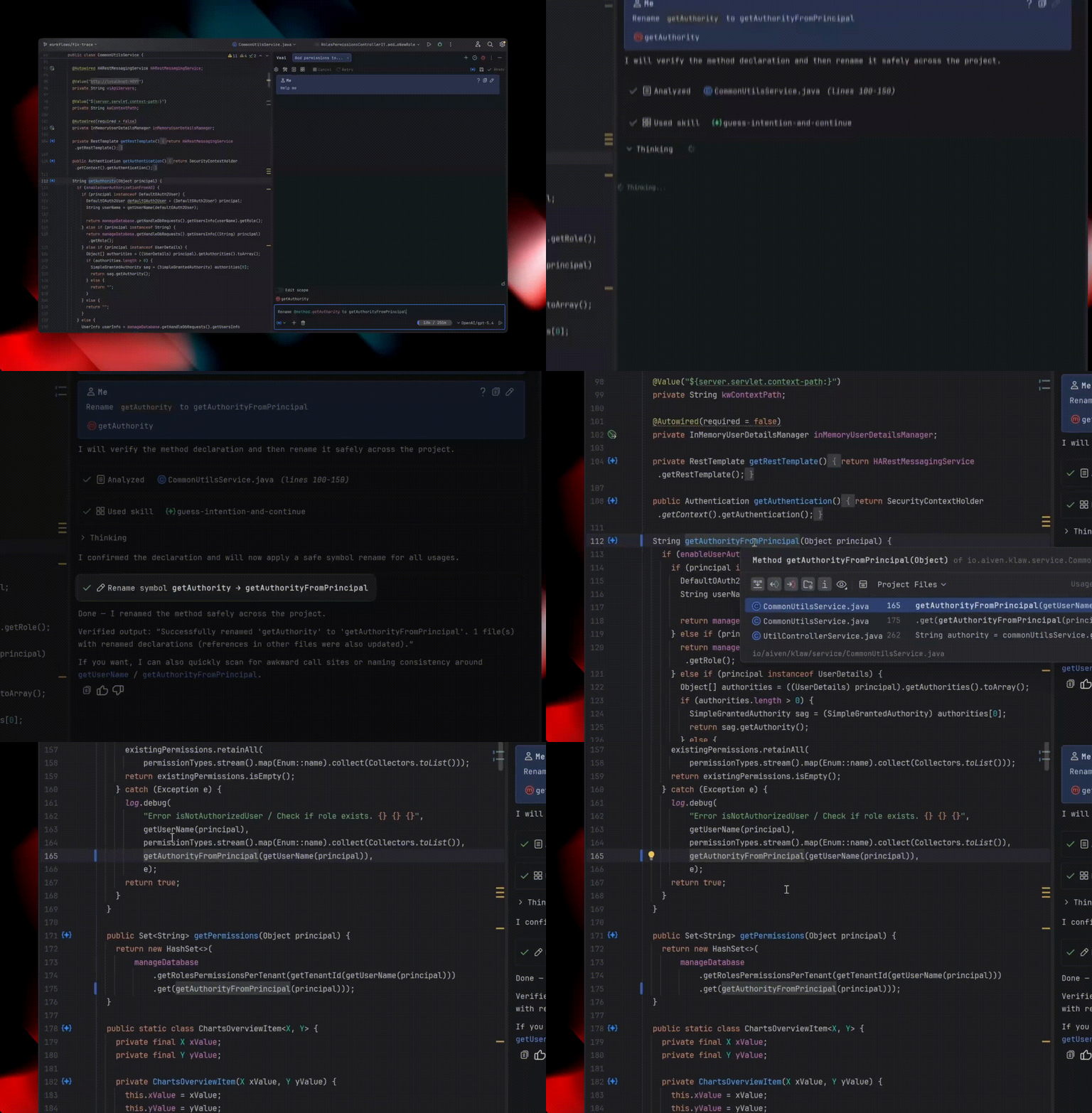
Explyt invokes a JetBrains IDE refactoring. This artifact shows the performed operation and the affected symbol; the compatibility of the change is confirmed by separate builds and tests.
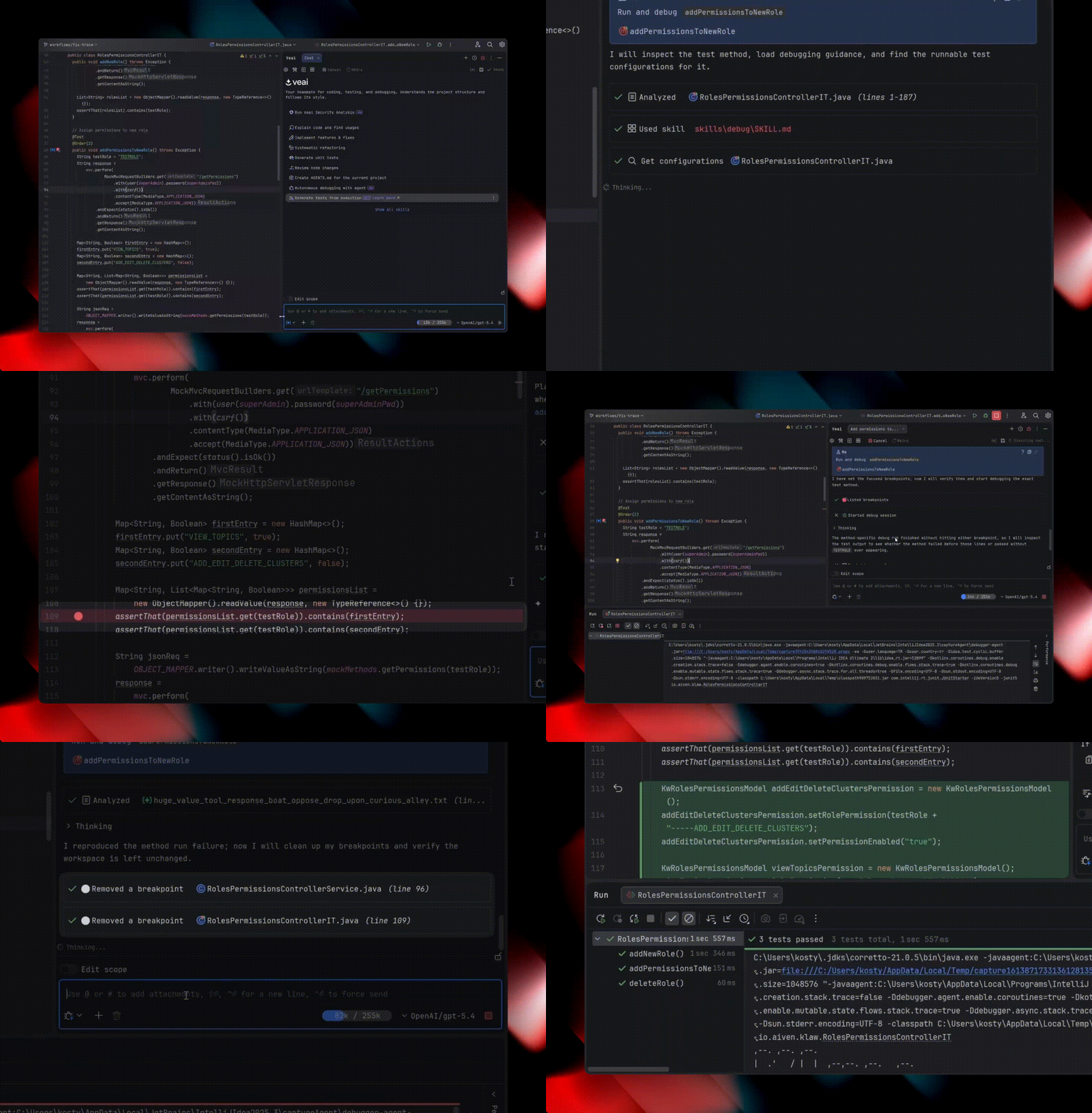
Debug mode provides evidence from one reproduced debug session, including configured breakpoints and observed runtime values. A regression suite is needed to check the remaining scenarios.
The card must name every confirmation and its limits. A report saying “everything passed” is weak for acceptance. The record “the payment-service:test configuration completed successfully, 126 tests were run, and the integration suite was not run” allows a person to understand what was checked and what remains.
Examples of assessing real tasks
Update a guide from agreed source materials
Conditions:
- the document structure is approved;
- the sources are listed;
- adding facts without a source is forbidden;
- an editor checks the final text;
- publication goes through separate approval.
Assessment: certainty 3, verifiability 3, error cost 1. The agent can prepare a complete draft and check the links. A person verifies the facts and wording and accepts the publication.
If sources conflict and the team has not identified an authoritative source, certainty falls to 1. If positioning has one limited unresolved question and a defined human checkpoint, certainty falls to 2. The task category remains the same, but the work mode changes.
Add unit tests to a pure function
Conditions:
- the function contract is specified with examples;
- edge cases are listed;
- neighboring tests show the accepted style;
- the test suite is reproducible;
- the change does not affect external systems.
Assessment: 3, 3, 1. The agent writes the tests and runs the suite. The developer checks that the tests follow the contract and can fail for an intentionally incorrect implementation.
If the expected behavior can be inferred only from the current code, certainty is no higher than 2. Such tests may lock in a defect.
Fix a reproducible defect in an isolated module
Conditions:
- an existing test reproduces the failure;
- the change area is limited to one module;
- the regression suite is stable;
- rollback is simple;
- the module does not process critical data.
Assessment: 3, 3, 1. The agent can go through the cycle from analysis to patch. Acceptance includes evidence that the test failed before the change, passes after it, and that the related suite has no new errors.
Add retries to an external call
The main scenario is agreed, but the existing timeouts and idempotency mechanism need to be studied. Unit tests exist, while the behavior of the real provider is checked manually in a test environment. An error may temporarily disrupt the function; release is protected by a flag.
Assessment: certainty 2, verifiability 2, error cost 2. The agent may be assigned the investigation and a limited implementation. After analyzing idempotency, the developer confirms the direction. Before release, the team checks the behavior in the test environment and verifies that the flag disables the change.
Change a payment calculation
Even with a formal contract, error cost is 3. The first matrix rule applies. The agent may find affected locations, prepare test data, and propose a patch. The specialist developer is responsible for the decision, independent tests, edge-case review, and release.
High verifiability allows the scope of the agent’s preparatory work to be expanded, but it does not remove human responsibility for a change with high error cost.
Design a monolith decomposition
Requirements for service boundaries are being clarified, dependencies have been studied only partly, the consequences of the decision are significant, and it is difficult to build full verification before migration.
Assessment: 1, 1 or 2, 3. The agent is suitable for building a dependency map, finding cycles, collecting data accesses, and preparing options. The team makes the architectural decision after investigation.
How to run a pilot on the team's tasks
The pilot must answer two questions:
- For which classes of tasks does the agent reduce active developer time at the required quality?
- Which properties of the task description and project explain the result?
Token consumption is included in the cost calculation. The team’s goal is to reduce active developer time while preserving the required quality.
Step 1. Build a representative sample
Take completed tasks from a period that reflects the team's workflow. The sample must represent the main categories in realistic proportions: fixes, features, tests, refactoring, integrations, documentation, and research. Include tasks with high error cost within their actual categories and report rare high-error-cost tasks separately.
If half of the time is spent supporting a legacy system, a pilot on new CRUD methods will produce a distorted result. If the sample contains one task of each type, random luck will look like a pattern.
Before the pilot, set a minimum number of comparable repetitions for each category. A category that does not reach its minimum receives preliminary status and stays outside the eligible set used for aggregate task-share calculations. Report its observations separately. Do not derive a stable percentage from a small set of rare high-error-cost tasks.
Build the baseline from comparable tasks. For each pilot task, select a recent manual task from the same category, a similar module, and a predefined complexity group, or compare medians within that group. Matching must account for the affected area, number of dependencies, available tests, and checking cost. If there is no reliable history, perform some new tasks through the current manual process and measure them the same way. Do not use incomparable tasks as evidence of savings.
Step 2. Calibrate assessors and score the cards
Before the main pilot, two assessors independently analyze one small shared sample. They assign levels to the three parameters, record their evidence, and compare their answers. For each parameter, the team calculates a simple share of matches:
Assessor agreement =
  cards with the same assessment
  / all cards in the calibration sample
Calculate the share separately for certainty, verifiability, and error cost. When assessors disagree, they clarify the criterion, add an example, or name a mandatory artifact. Then they repeat calibration on a new small group of cards. Start the pilot after reaching a predefined agreement threshold. On a small sample, this indicator reflects the uniformity of assessments within the team. Check the stability of the conclusions on subsequent groups of cards.
After calibration, two people independently assess the cards in the main pilot. One developer may know about a hidden integration while another considers the task isolated. Their disagreement can surface hidden context before the agent changes the code.
If assessors have not agreed on a level, choose the more cautious mode and record which fact is missing. Preserve the initial assessment: it must not be changed after a successful result to make the forecast look more accurate.
Step 3. Set boundaries and the stop criterion
Before launch, specify:
- which directories, modules, and files may be changed;
- which commands or configurations may be run;
- which actions require confirmation;
- which data and environments are forbidden;
- on which event the agent must stop;
- who accepts the result.
Examples of stop conditions: the need to change a public contract, discovery of a data migration, leaving the permitted module, an unstable test, no access to the required configuration, or a conflict between requirements and current behavior.
Step 4. Record the unmet criterion first
For a defect fix, reproduce the failure before the patch. For a new feature, run an acceptance scenario that does not yet pass. For documentation, save the list of mandatory facts and sources. For a refactoring, record the original symbol, the area of its usages, and compatibility checks.
This sequence shows that the check distinguishes the states before and after the work. If a test was already green before the change, its passing again does not confirm the agent’s result.
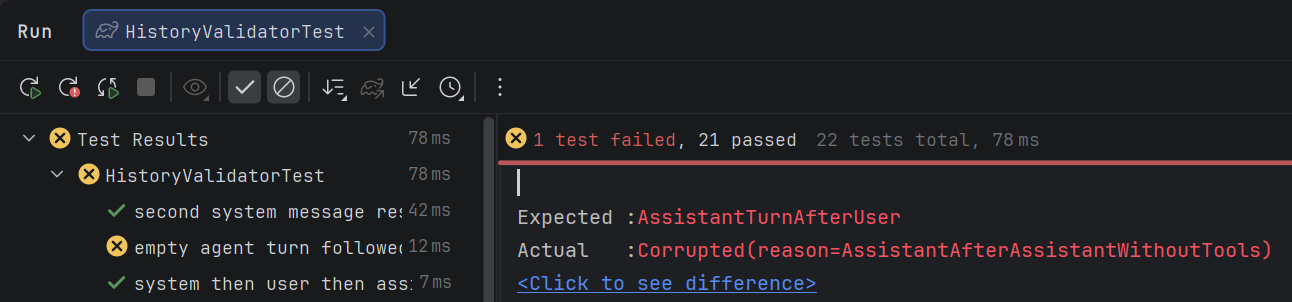
The Test Results window records the configuration name, number of tests, run time, and the difference between the expected and actual results. The screenshot confirms one run; the repeat check after the fix must be saved separately.
Step 5. Perform tasks in the assigned mode
Follow the selected mode. Do not let a low-certainty task drift into a long autonomous session after launch. A task with high error cost must not enter a merge without an assigned review.
For collaboration, define the scope of each checkpoint in advance: one hypothesis, one module, one test scenario, or a limited diff. Checkpoints are also part of active developer time.
Step 6. Measure the full cycle
For every attempt, record:
- time spent preparing the task description and context;
- active time communicating with the agent;
- autonomous machine time;
- waiting time that the developer actually used for other work;
- time spent checking evidence and the diff;
- time spent on manual fixes;
- number of retries;
- rework outcome: accepted as returned, accepted after minor rework, accepted after substantial rework, or rejected;
- checks performed and skipped;
- defects found before merge and defects found during a predefined post-merge observation window;
- model cost, including retries;
- the reviewer’s subjective workload on a short scale, for example from 1 to 5.
The main time metric:
Active developer time =
  task description
  + active interaction
  + checking
  + manual fixes
  + recovery after defects
Autonomous machine time is stored separately. If the agent worked for twenty minutes while the developer was solving another task, those twenty minutes must not be added in full to human costs. If the developer watched the process the whole time and answered questions, that is active work.
Step 7. Review evidence independently of the agent's summary
The accepting developer reviews the saved evidence:
- the original criterion was in fact unmet;
- it was met after the change;
- the configurations run and the scope of the checks are named;
- skipped checks are visible;
- the final diff matches the boundaries;
- there are no forbidden changes;
- the remaining risks are clear to the developer accepting the result.
The agent’s phrase “task completed” does not confirm the result.
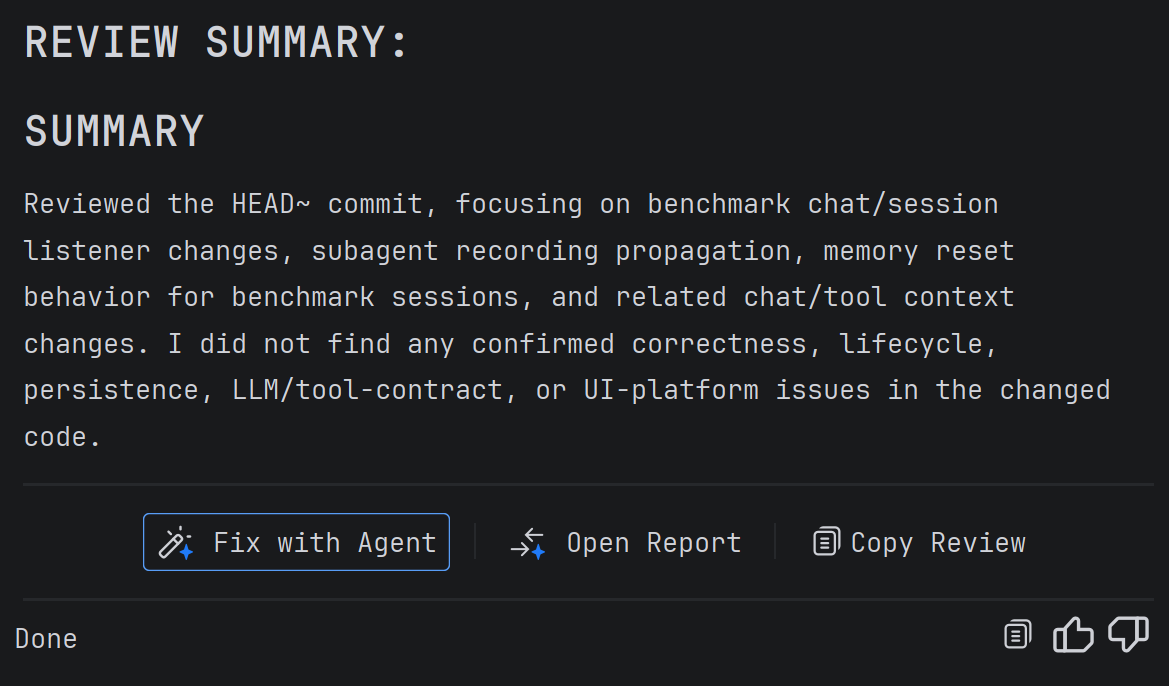
The Auto Review result stores the checked area and the findings for the changed code. The report complements the results of tests, inspections, and diff review listed in the acceptance criteria.
Step 8. Compare with the baseline within each category
Compare local fixes with local fixes, documentation with documentation, and integration tasks with integration tasks. Within a category, use matched pairs of similar complexity or predefined complexity groups. An overall average across different work classes hides the causes of the result.
For each eligible category, calculate the median active developer time, the share of results accepted without substantial rework, retry frequency, and post-merge defects. State alongside them the number of observations, matching method, and complexity range. Report categories below the minimum number of repetitions as preliminary observations outside aggregate shares.
Step 9. Analyze forecast errors
There are two useful error types:
- the task was considered suitable, but the agent created more work;
- the task was considered unsuitable, but a limited mode produced a good result.
For the first case, find the missed factor: an implicit requirement, a weak test, a dynamic dependency, boundaries that were too broad, costly checking, or insufficient project context. In the second case, record which artifact reduced uncertainty or strengthened verifiability.
After several cycles, the team will obtain rules for its recurring tasks. These rules must be reviewed after changes to the architecture, test infrastructure, model, toolset, or release requirements.
How to calculate task shares
Use four separate indicators. In every aggregate formula below, eligible tasks means tasks from categories that reached their predefined minimum number of comparable observations.
1. Forecast share of autonomous delegation
Forecast share =
  eligible tasks that fall under matrix rule 6
  / all eligible assessed tasks
It shows the potential based on the cards before launch. The autonomous mode includes only tasks with high certainty, high verifiability, and low error cost. Rule 5 concerns collaborative work.
2. Confirmed share
Confirmed share =
  accepted eligible tasks from autonomous mode,
  where active developer time is below the baseline
  and there is no disqualifying defect
  / all eligible pilot tasks
The team defines a disqualifying defect before the pilot. It may be a rollback, an incident, a data violation, a missed mandatory check, or manual rework comparable to a new implementation.
The strict denominator shows what part of the overall stream can already be delegated with confirmed value. Success can also be calculated separately only among launched autonomous tasks.
3. Share of tasks for collaborative work
Collaborative-work share =
  accepted eligible tasks from rules 3, 4, and 5,
  where active time is below the comparable baseline,
  there is no substantial rework
  and there is no disqualifying defect
  / all eligible pilot tasks
Set quality criteria and the list of disqualifying defects before launch, as with the confirmed share. Report collaborative work separately from autonomous delegation so the team can see where the agent works autonomously and where short checkpoints reduce developer effort.
4. Effort-weighted share
Ten small fixes and one week-long integration produce the same eleven tasks but affect workload differently. Therefore, alongside the count-based share, calculate a weighted share:
Weighted confirmed share =
  sum of baseline human time for confirmed eligible tasks
  / sum of baseline human time for all eligible sampled tasks
The weight comes from baseline human time. Agent generation time does not affect the weight. The indicator answers the question of what part of the previous human workload is covered by successfully delegated tasks.
Do not combine these four values into one index. It is more useful for a manager to see separately the autonomous-mode share, collaborative-work share, number of observations, and categories in which active developer time decreased.
Metrics to keep on the dashboard
A pilot dashboard can be assembled from eight groups of indicators:
- Coverage: number of assessed tasks and distribution by category.
- Modes: forecast autonomous share; confirmed autonomous and collaborative shares; assignment counts for preparatory assistance. Preparatory assistance has no success-share metric because the method does not treat it as delegation.
- Acceptance: share of results accepted without substantial rework, reported separately from the confirmed autonomous share.
- Human time: median active time and change relative to the baseline.
- Checking: median review time and a list of performed and skipped checks.
- Retries: how many reruns were required before acceptance.
- Quality: defects found before merge, defects found during the predefined post-merge window, rollbacks, and incidents.
- Economics: model cost per accepted task and per saved hour of active time.
Tokens can be stored as technical cost detail. Their growth shows an increase in cost, but cannot be used to judge pilot success. An agent with a larger context may spend more tokens and reduce checking. A more economical agent may return a patch that the team deletes.
Task assessment card
Task:
Category:
Module or system:
Complexity group:
Expected result:
What must remain unchanged:

ASSESSOR 1
Name or role:
Assessment date and criteria version:
Certainty: 1 / 2 / 3
Verifiability: 1 / 2 / 3
Error cost: 1 / 2 / 3
Evidence and rationale:

ASSESSOR 2
Name or role:
Assessment date and criteria version:
Certainty: 1 / 2 / 3
Verifiability: 1 / 2 / 3
Error cost: 1 / 2 / 3
Evidence and rationale:

RECONCILED ASSESSMENT
CERTAINTY: 1 / 2 / 3
Unknown questions:
Who makes product and technical decisions:

VERIFIABILITY: 1 / 2 / 3
How to show the unmet criterion before the change:
Independent acceptance criterion:
Which builds, tests, inspections, and runs are available:
What behavior is checked at runtime:
What will remain unchecked:

ERROR COST: 1 / 2 / 3
Who and what the defect will affect:
Can error propagation be stopped:
Rollback method and time:
What will not be restored after rollback:

MODE FROM THE MATRIX
Matched matrix rule: 1 / 2 / 3 / 4 / 5 / 6
[ ] Autonomous execution by the agent
[ ] Short-step collaboration
[ ] Preparatory assistance

Required controls from the matched rule:
[ ] Build a checking method first
[ ] Human checkpoint after each investigative step
[ ] Mandatory checkpoint and expanded result review
[ ] Independent review
[ ] Safe-release plan
[ ] Steps defined and approved in advance

Permitted files, modules, and actions:
Forbidden actions and environments:
Stop condition:
Checkpoint:
Who accepts the result:

BASELINE
Baseline task, pair, or group:
Baseline active developer time:
Matching method:
Complexity range:

AFTER EXECUTION
Task-description and context time:
Active interaction time:
Checking time:
Manual-fix time:
Recovery-after-defects time:
Active developer time total:
Autonomous machine time:
Waiting time used for other work:
Retries:
Rework outcome: accepted as returned / minor rework / substantial rework / rejected
Checks performed:
Checks skipped:
Defects found before merge:
Post-merge defects:
Post-merge observation window:
Model cost:
Reviewer workload, 1-5:
Outcome: accepted / accepted after rework / rejected
Method limitations
The matrix does not assess model quality separately from the environment. One agent can use project tools, while another is limited to reading files and terminal commands. Their results on the same card may differ.
Assessment depends on the team's knowledge. A developer who has been responsible for a module for many years sees hidden constraints. A new contributor may not know them. The card therefore stores both assessors, their original scores, and the evidence behind each score.
Automated checks confirm only the expectations built into them. High coverage does not help if tests preserve outdated behavior. Significant changes need a criterion connected to a real user or system scenario.
The accuracy of historical time depends on the accounting method. If the baseline was collected from subjective estimates, label the savings conclusion as preliminary. It is better to measure the manual and agent processes in the same way.
The confirmed share describes the studied sample under the current architecture and selected toolset. For another team, calculate it again in its own pilot.
Conclusion
This method identifies recurring tasks where an AI agent can reduce active developer time and still meet the team's acceptance criteria. Certainty, verifiability, and error cost determine the work mode; pilot results then show whether autonomous or collaborative work delivered measurable value against a comparable baseline.
Start with a calibration sample and set the minimum number of observations for each category. If verifiability is the bottleneck, improve reproducible builds, tests, inspections, run configurations, and reproducible debug scenarios with captured runtime evidence.
In JetBrains projects, Explyt can use semantic code information, named run configurations, test results, inspections, and debugger state during the agent workflow. A person still owns the acceptance criteria and the merge decision.